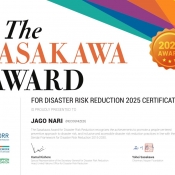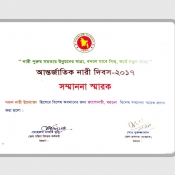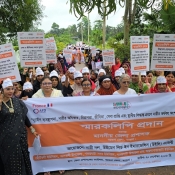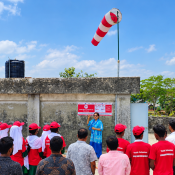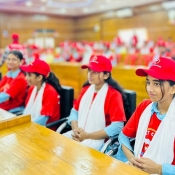


The Sasakawa Award Certificate 2025: Achievements of JAGO NARI

The Sasakawa Award for Disaster Risk Reduction 2025 certificate is praudly presented to JAGO NARI (Recognized).
The Sasakawa Award for Disaster Risk Reduction recognizes the achivements to promote a people-centered preventive approach to disaster risk, and inclusive and accessible disaster risk reduction practices in line with the Sendai Framework for disaster Risk Reduction 2015-2030.
What is SASAKAWA Award?
Together with the World Health Organization Sasakawa Health Prize and the UN Environment Programme Sasakawa Environment Prize, the United Nations Sasakawa Award for Disaster Risk Reduction is one of the three prestigious prizes established in 1986 by the founding Chairman of the Nippon Foundation, Mr. Ryoichi Sasakawa. The United Nations Sasakawa Award for Disaster Risk Reduction is awarded to an individual or institution that has made active efforts to reduce disaster risk in their community and advocates for resilience.
The call for nominations was the 2025 United Nations Sasakawa Award for Disaster Risk Reduction is open, under the theme “Connecting science to people: democratizing access to innovation and technology for disaster resilient communities”.
Theme
The theme for the 2025 Sasakawa Award is “Connecting science to people: democratizing access to innovation and technology for disaster resilient communities.” The award will recognize efforts by individuals and organizations to disseminate scientific knowledge for community resilience. Nominations may also include efforts to locally led efforts to develop or proliferate novel and appropriate technological solutions for community resilience.
We live in a multi-hazard world where disasters affect everyone, while exacerbating existing inequalities and disproportionally affecting the most at risk. At the same time, inter-connected disaster impacts cascade across geographies and sectors. Managing complex and interconnected risks is a pressing global challenge of today.
The Sustainable Development Goals and targets of the Sendai Framework for Disaster Risk Reduction cannot be reached without accelerated action to build community resilience. We have the knowledge and the solutions to overcome these challenges. Access to science and technology provides the opportunity to urgently leapfrog the challenges of today and harness resilience for a safe and prosperous future. Solutions to our global challenges are being generated at all levels, from the grass-roots to the global.
The Sasakawa Award focuses on the promotion of inclusive and resilient approaches in disaster risk reduction, reflecting the all of society approach outlined in the Sendai Framework. The 2025 Sasakawa Award will celebrate efforts made by institutions, individuals and groups that have contributed to building resilience through the democratization and access of science and technological solutions, wherever they are developed.
What does this Award recognize?
The Sasakawa Award will recognize selected candidates (individuals, groups, organizations, local authorities, etc.) through an award accompanied by a grant. The Award promotes importance of a more people-centered preventive approach to disaster risk, as well as inclusive and accessible disaster risk reduction practices, in line with the Sendai Framework.
Who can be nominated?
Candidates should be individuals or groups who are already working in the field of disaster risk reduction and are able to present their achievements. In addition to recognizing individuals or groups for their achievements, the Sasakawa Award also seeks to encourage and support to continue their good work with the grant and the visibility it brings.
It is possible to nominate an individual or an institution such as a community group, civil society organization, government agency at local or national level, NGO or private sector entity for this Award. Previous winners cannot be nominated again; and a nominator cannot nominate themself or the organization at which they work.
Candidates should have had some engagement with UNDRR-related processes or initiatives, such as the National, Regional or Global Platforms, the Making Cities Resilient Initiative, or other stakeholder-based network.
Source: UNDRR
Published on: Tuesday, 12 August 2025, 07:23 pm ▪ Last update: Tuesday, 21 October 2025, 09:57 am ▪ Total View of this Page: 1310